Built St. Louis > > The Industrial City > > The Bridges > > MacArthur Bridge
|
|
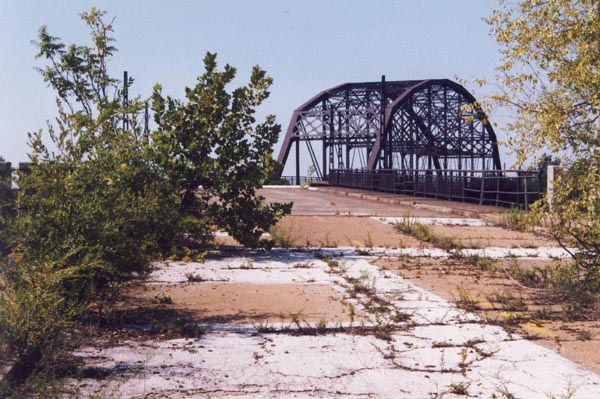
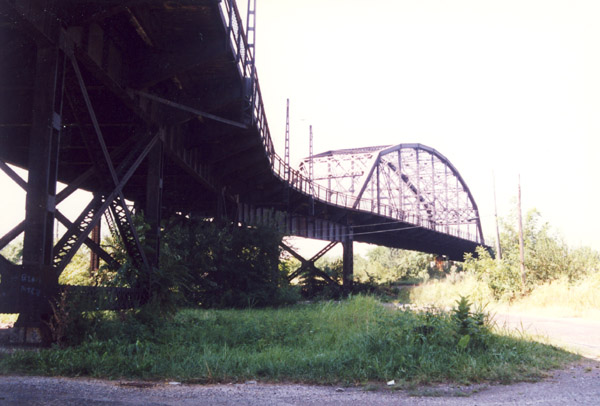
MacArthur Bridge car deck The long-contentious MacArthur Bridge opened in 1917 as the Municipal Free Bridge (as it was the only one which did not charge a toll), and was renamed in 1942 for the World War II general. For several years it carried Route 66 - the main drag through the western half of the country - into Missouri and St. Louis. The bridge was built by the city of St. Louis itself, a bid to break the Eads Bridge's monopoly on road traffic crossing the river. The bridge itself was ready for service in 1912, but money shortages meant that the lengthy approach ramps (several miles' worth of rail and road on the Illinois side) were not completed for another five years. The bridge finally opened for rail traffic in 1928, but the major railroads - all members of the competing Terminal Railroad Association - would not use it for another twenty years. The MacArthur remained a popular and heavily used road route across the river, carrying the city of Route 66 into Missouri. Even a toll of ten cents, instituted in the early years of the Depression, did little to reduce its popularity. Along with the traffic came a steady stream of accidents, as faster cars and faster driving speeds made it increasingly difficult to negotiate the sudden jogs where the car deck veers to join up with the trusses of the birdge. Enough cars crashed through the rails and plummeted a hundred feet or more to the ground that a newspaper article dubbed the roadway "Death's diving board". However, it was not danger which proved to be the roadway's undoing, but the coming of the Interstate system. The massive Poplar Street Bridge opened in 1967, and immediately drew away nearly all of the MacArthur's car traffic; soon the tolls were not even covering the tolltakers' payroll. The aging car deck was also badly deteriorated after decades of traffic and weather. It was closed to cars in 1981, and the MacArthur has been a rail-only bridge ever since. In 1989, the Terminal Railroad Association assumed ownership of the bridge, trading it for the Eads Bridge, which had become unworkable for freight rail traffic. TRA is reported to be adamantly opposed to re-opening the car deck. A section of the east approach was removed in 1989 to discourage those attempting to enter the bridge. A more comprehensive demolition campaign destroyed a good half-mile of the Illinois-side road approaches in 2003, further decreasing the likelyhood that this spectacular bridge will ever see upper-deck traffic again. The MacArthur's enormous steel trusses and stone piers form a presence that is astonishing to stand beneath, the most powerful and awe-inspiring of the city's bridges. Though not graceful, it commands respect through its sheer size and height (equivalent to a fourteen story building.) It is the product of an age that believed in the promise of infinately bigger and more powerful machines. Appropiately, lumbering freight trains still run regularly on its lower deck today. The bridge seems strangely detached from the life of the city around it; even the space beneath it - one of the most humbling in the city - is little more than a hobo camp and fisherman's site at the south end of the Arch grounds. To this day, I retain quixotic dreams of the car deck reopening, either as a local bridge for car traffic, or a bike path and observation deck. Reopening MacArthur to car traffic would not solve St. Louis's long-standing trans-Mississippi traffic problems; the car deck is too narrow and twisty to handle heavy loads, and the bridge does not lead to any major streets. But pedestrian and bicycle traffic would be another matter altogether. Routing a bicycle path over the bridge (as was done with the the Chain of Rocks Bridge) would be a wonderful addition to the city's riverfront bike trail network. Off-site links: |
|
|
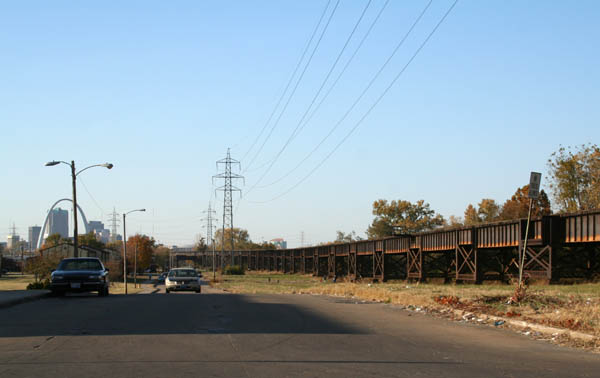
The Missouri-side approaches weave their way through a tangle of cityscape and trestles. Two rail lines feed onto the bridge, one heading directly east-west, and the other curving south-to-west as it rises to meet the bridge. |
|
|
On the Illinois side, by contrast, the approach trestles run through forests and swampy flood plains, gradually bringing trains up to the great height of the bridge. The approach trestles run nearly two miles back the switching yards in East St. Louis. |
|
|
On the Illinois side, nearly a half mile of the old car deck approach ramp has been removed, including a portion of the deck on the bridge itself, as well as the section shown at left. |
|
|
What's left of the car deck comes down onto 10th Street in East St. Louis, a surprisingly unremarkably street in a nondescript neighborhood south of downtown East St. Louis. Whatever good economic fortunes were brought here by the bridge's arrival have long since vanished. |
|
|
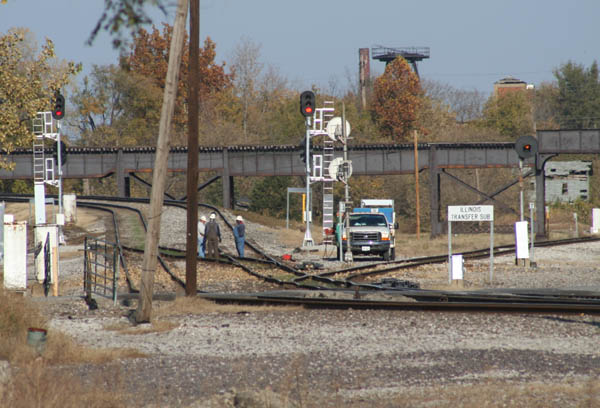
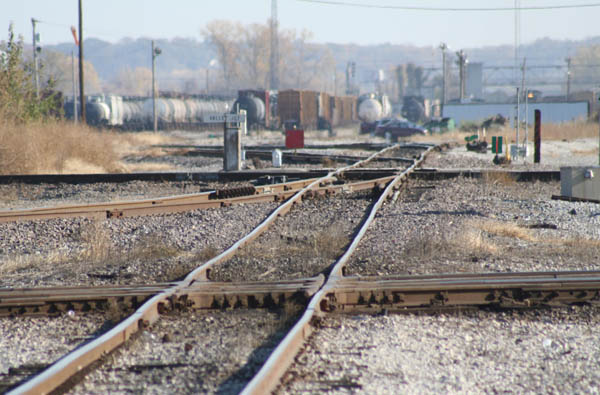
Two tracks meet up in mid-air on the Illinois side approaches. One trestle curves away to the north, heading toward Alton. The other continues east and eventually touches ground at this vast switching yard in East St. Louis. |