Built St. Louis: Crumbling Landmarks
The Arcade Building

November 2006:
On a sunny Sunday morning, after scarfing some tasty crepes at Washington Post, I had the great fortune to go on a tour of the Arcade Building's interior, given by Pyramid Architects, a spinoff company of building owner Pyramid Construction. Myself and four companions were conducted through the building by Pyramid architect Paul Hohmann.

We entered through the elevator lobby in the Wright Building, which intersects the retail arcade at right angles. Ten years after I first pressed my nose to the glass on Olive Street, I finally stood within the magnificent space, so long deserted and dark.

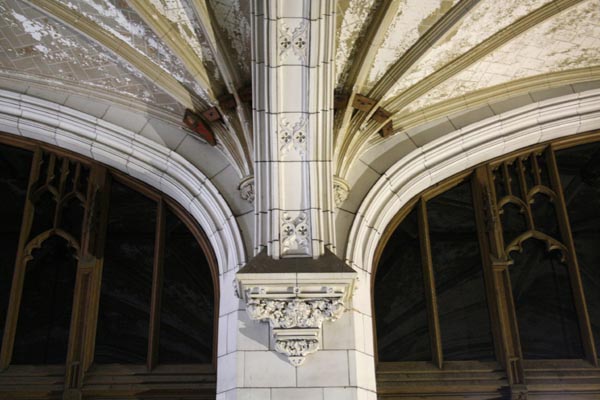
The retail spaces of the arcade are in ruins, smashed, broken, molded and dusty; they will require wholesale gutting. Some plaster vaulting has fallen, and many of the glazed tiles have lost their facing. The hanging chandoliers are long gone, only a few dangling chains remaining. But the woodwork, the railings, the tiled vaults, the ceiling plasterwork, indeed the space as a whole, is mostly intact. Pyramid had run in work lights through the space, making our exploration much easier.

As we poked about the arcade, I began to discover a number of oddities to it. The mezzanine level is connected with the ground floor of the arcade by a staircase at the south end, creating a rather lonely pocket of isolation on the north end. And the mezzanine level doesn't run consistently through the building; the vestibule on the north end juts up into it. The north end of the arcade is faced with a huge mirror, creating the illusion of a much larger space; in the vestibule, the opposite side of the same wall is given the same treatment -- which had long confused me as I stared into the vestibule from the street.

Gallery: The Retail Arcade


Trudging up one level on some secluded steps from the mezzanine level, we entered the building's finest office spaces. Here, the vast bay windows fill the rooms with copious natural light, as well as giving delightful views of the street two stories below. The shear size of the glass must have pushed the limits of glassmaking technology at the time -- what prime tenant space it must have been! And so it shall be again.

Gallery: The Bay Windows


The desolation continued as we climbed further. Floor after floor offered ruined tenant spaces: jewelers, doctors' offices, office space, a printing company. The jewelers were especially common.

All were filled with peeling paint (a great deal of it in shades of lime green -- must've been a sale some time after the War), falling suspended track, half-hanging light fixtures, broken glass, smashed partitions. Furniture was long gone; partitions were falling apart. Soggy ceiling tiles covered many floors, a few with moss or plants growing out of them. Mostly the rooms were full of rubble: broken plaster and lath, falling light fixtures from post-War remodellings, paint flecks, broken radiators, unidenifiable rubble. Some of the bay windows have lost their massive panes of glass and stand open to the elements; the walls around them are often stripped down to bare brick.

We discovered the hulks of several defunct typesetting machines in one of the larger spaces, a former printing operation apparently known as Law Publishing, along with numerous scattered legal documents from the late 1970s. Large gears and other massive spare parts were scattered about in decomposing boxes and on the floor. Printing fans have identified the typesetting machines as "Linotype Comets"; these contraptions used molten metal to cast the type used by printing presses.

Adding machines and a lonely 1920s-style wood office chair populated another office, along with a posted notice that part of the suite was a "factory".

Our host noted that interior demolition alone was expected to take six months. A few places have had some marginal cleanup work done. Taped notes and hanging extension cords bring direction and power up the stairwells.

The view into the conjoined buildings' light wells was sobering; they were filled with moss, bricks and debris. Most will require complete roof reconstruction.

Gallery: Upper Stories in Ruins


With time beginning to run short on our tour, we regretfully opted to skip the last 7 or 8 floors, and head straight for the top. My legs were on fire by the time we reached the mechanical level at the top.

There, we passed massive, ancient, rusting boilers; a room piled high with bricks from the Wright Building's temporarily de-constructed parapet walls; and several dark, narrow rooms lit only by the cloverleaf openings cut into the stone panels below the building's cornice.

Stepping onto the roof was a thrill; half of downtown lay at our feet, and the perspective on neighboring buildings like the Paul Brown and the Syndicate Trust was fantastic. A different kind of thrill came from knowing that the roof was not in the best of conditions after 30 years of neglect; we were told to avoid several large areas. I shot some high-powered views of our surroundings before we headed down.

We made a quick descent, pausing only to collect a few soveniers we'd gathered: non-original fittings, and a couple of bits of old door hardware too damaged for restoration. Pyramid intends to reuse original materials wherever possible, so we avoided taking anything that could be restored.

It was a fascinating two hours; I could have stayed there all day. I'm enormously grateful to Pyramid for providing me access to the last of downtown's abandoned great skyscrapers.

Gallery: View From the Top


The Wright Building || The Arcade Building

- Arcade Building: Ornament
- Arcade Building: Interior
- Arcade Building: Interior Tour
- The Arcade-Wright: Present and Future
Next site